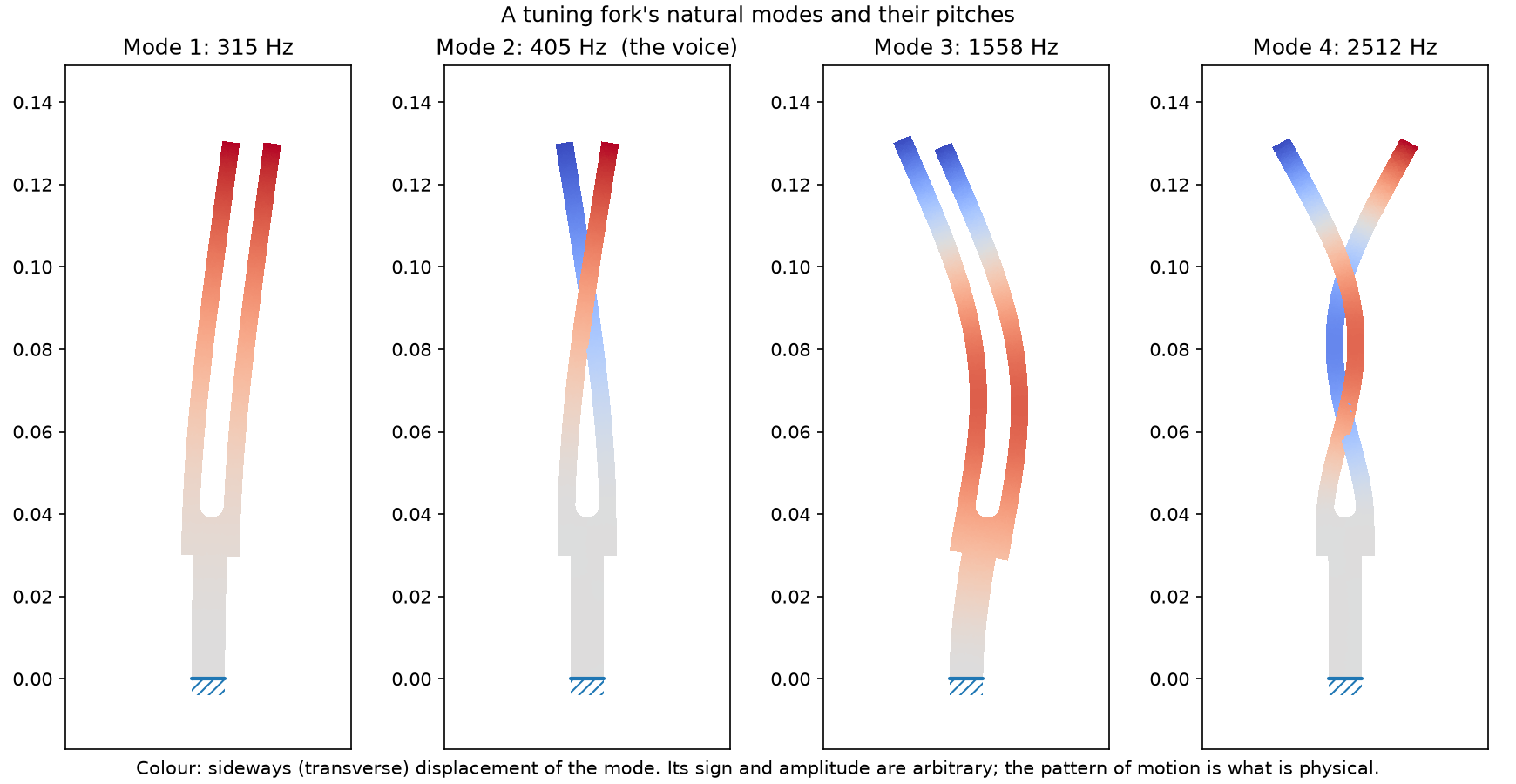
Natural frequencies and modes of a steel tuning fork meshed from its outline, against beam theory; then the fork struck and ringing down.
uv run python examples/cli.py run modal
A steel tuning fork (E=2e+11 Pa, rho=7850 kg/m^3), meshed from its outline.
tine length x thickness   88 x 4.0 mm
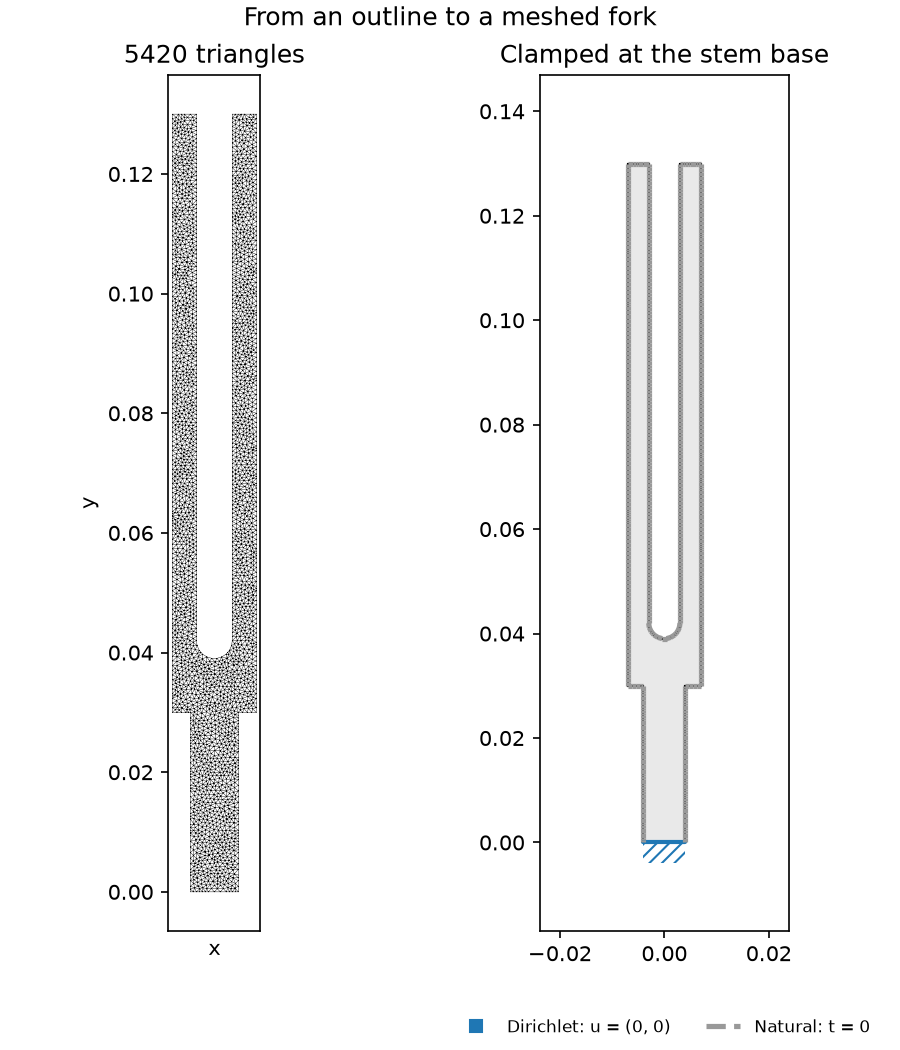
mesh                      5420 P2 triangles

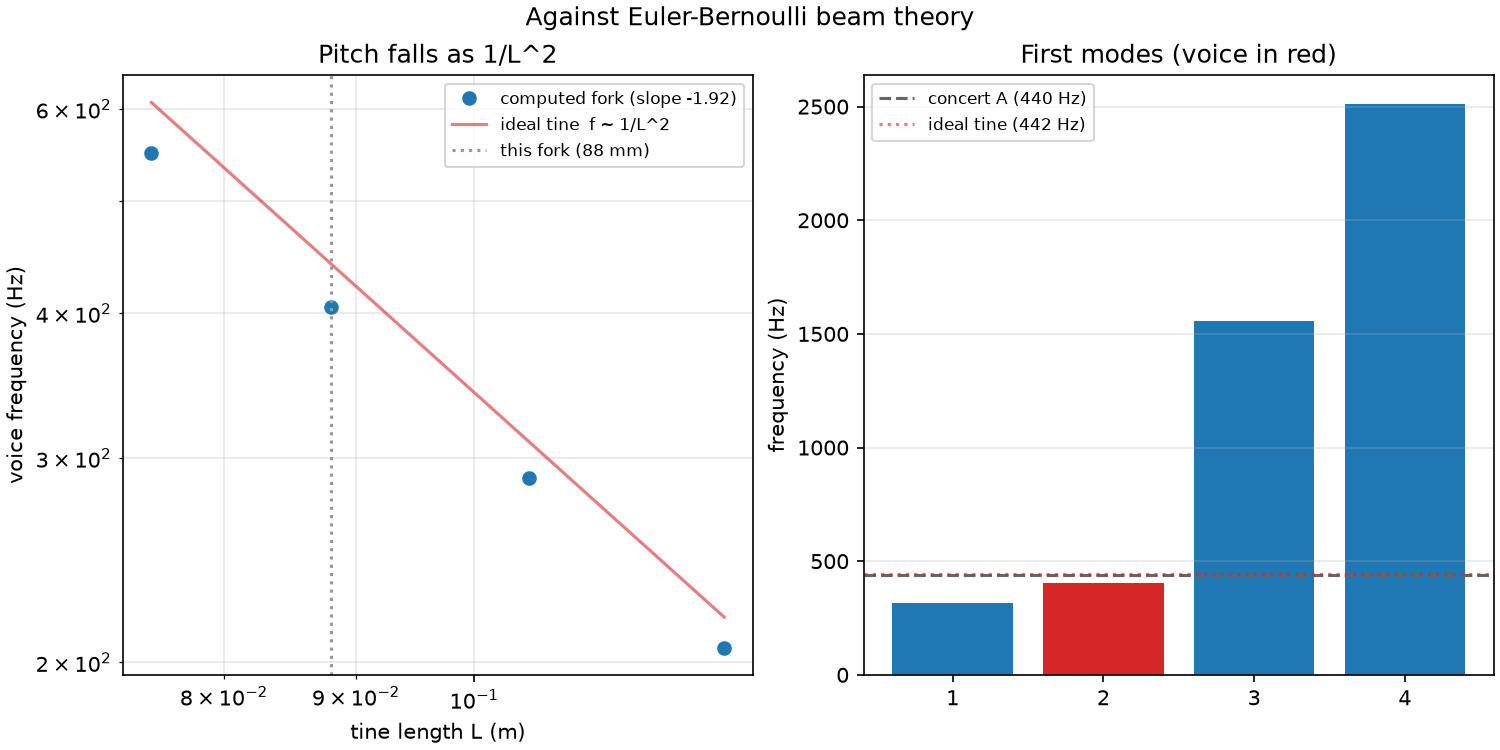
ideal clamped tine (beam theory)   442 Hz
fork voice (mode 2, computed)      405 Hz   (-8%: the base is not a rigid clamp)
first 4 modes (Hz)             315  405  1558  2512
tuning law   f ~ L^-1.92         (beam-theory exponent -2)
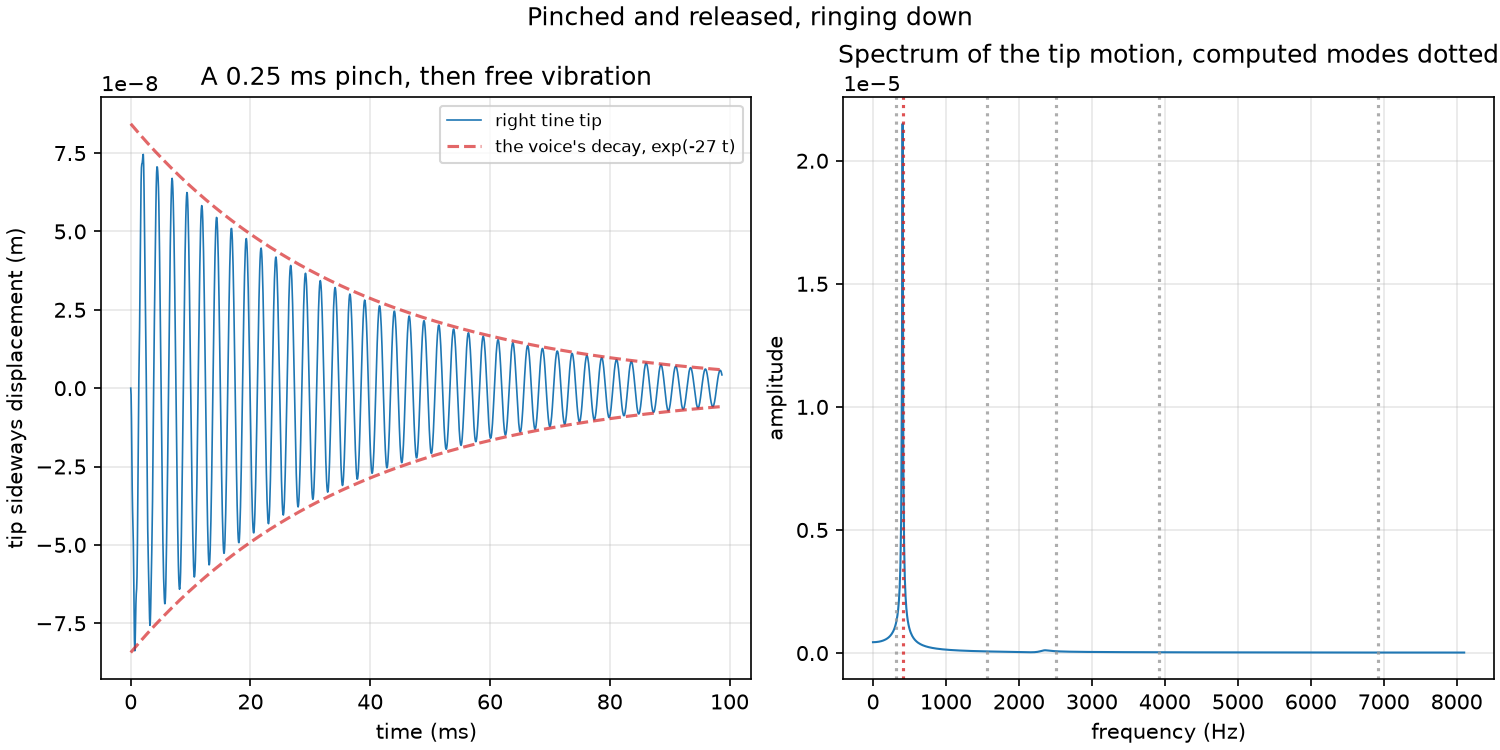
struck: Rayleigh damping alpha = 27 /s, beta = 4.17e-06 s; the voice at 1/e after 15 periods (37 ms); mode 4 (2512 Hz) after 1.9 ms
The functions that pose and solve the problem. The figures are below the fold.
"""A steel tuning fork meshed from its outline: its modes, its tuning law, and its
ring-down when struck.

`fork_modes`, `voice_index`, and `strike` each state and solve one problem; `run` calls
them and returns a `ForkStudy` of plain results. Nothing here draws: `figures.py` does
that from the `ForkStudy`, and this file is what the gallery shows.
"""
from dataclasses import dataclass

import numpy as np

from fem.algebra.integrators import NewmarkMethod
from fem.analysis.modal import ModalAnalysis
from fem.boundary import Dirichlet
from fem.conditions import Conditions
from fem.elements import QuadraticTriangleElement
from fem.loads import PointLoad
from fem.mesh.mesh import Mesh
from fem.mesh.outline import Outline
from fem.physics.equations import LinearElastic
from fem.post.solution import ModalSolution, TransientSolution
from fem.problem import RayleighDamping
from fem.regions import TimeDependent, at_indices, on_plane


def tuning_fork_outline(tine_length: float = 0.088, tine_thickness: float = 0.004,
                     gap: float = 0.006, base_height: float = 0.012,
                     stem_length: float = 0.030, stem_width: float = 0.008,
                        n_fillet: int = 12) -> Outline:
    """A two-tined tuning fork, upright with its tines pointing up.

    One non-convex outline: a stem rises into a base that forks into two tines with a
    slot between them. Traced counter-clockwise from the bottom-left of the stem, with
    a rounded valley (radius `gap/2`, `n_fillet` points) at the slot root in place of
    two sharp reentrant corners.

    Dimensions are in metres; the defaults size a steel fork near concert A (see
    `demo_modal`). Centred on x = 0, with the stem base on y = 0, the line a modal solve
    clamps.
    """
    half_outer = gap / 2 + tine_thickness       # tine outer edge, |x| at the tips
    y_base_top = stem_length + base_height       # where the tines and the slot begin
    y_tip = y_base_top + tine_length

    # The slot root as a rounded valley joining the two reentrant corners at
    # (+-gap/2, y_base_top): an ellipse, x-radius gap/2 so its ends land exactly on the
    # corners, y-depth capped to stay inside the base. theta pi -> 2pi runs left corner
    # -> bottom -> right corner, so the valley's endpoints replace the corners rather
    # than duplicating them (which validation would reject).
    depth = min(gap / 2, 0.8 * base_height)
    theta = np.linspace(np.pi, 2 * np.pi, n_fillet)
    valley = np.column_stack([(gap / 2) * np.cos(theta), y_base_top + depth * np.sin(theta)])

    outline = np.array([
        [-stem_width / 2, 0.0],                  # stem base, left
        [-stem_width / 2, stem_length],          # up the stem
        [-half_outer, stem_length],              # out to the base's left edge
        [-half_outer, y_tip],                    # up the left tine's outer edge
        [-gap / 2, y_tip],                       # across the left tip, then down the
        *valley.tolist(),                        # inner edge into the valley and up again
        [gap / 2, y_tip],                        # to the right tip
        [half_outer, y_tip],                     # across the right tip
        [half_outer, stem_length],               # down the right tine's outer edge
        [stem_width / 2, stem_length],           # in to the stem
        [stem_width / 2, 0.0],                   # down the stem to the base
    ])
    return Outline.from_polygons([outline])

# Real SI steel, so the frequencies come out in Hz a musician would recognise.
E, NU, RHO = 2.0e11, 0.3, 7850.0             # Young's (Pa), Poisson, density (kg/m^3)
E_STAR = E / (1 - NU**2)                      # the plane-strain modulus a 2D solve sees
BETA1_SQ = 1.875104**2                        # first fixed-free beam root, squared

# Grounded at the stem base: the fork's node, held without damping the voice. A free
# body has rigid-body modes the shift-invert eigensolve cannot factor through.
clamp = Conditions(Dirichlet(on_plane(1, 0.0), [0, 0]))


def cantilever_hz(length, thickness):
    """The ideal clamped-free tine's fundamental (Hz): a bare beam, with no base."""
    return BETA1_SQ / (2*np.pi) * (thickness / length**2) * np.sqrt(E_STAR / (12*RHO))


def fork_modes(tine_length, tine_thickness, n_modes, across, min_angle=27) -> ModalSolution:
    """Mesh a fork from its outline and solve its first `n_modes` on P2 elements.

    The element size is set by resolving the thin tine, `across` elements through its
    thickness, since bending curves across it.
    """
    outline = tuning_fork_outline(tine_length=tine_length, tine_thickness=tine_thickness)
    mesh = outline.mesh(min_angle=min_angle, max_area=0.5*(tine_thickness/across)**2)
    problem = LinearElastic(E, NU, density=RHO).problem(
        mesh, clamp, element_type=QuadraticTriangleElement)
    return ModalAnalysis(n_modes=n_modes).solve(problem)


def voice_index(fork: ModalSolution, tine_length) -> int:
    """The acoustic mode: the lowest whose two tine tips swing in opposite directions.

    A clamped fork's low modes come in pairs: the tips moving together (a rocking that
    shakes the stem, damped the moment the fork is held there) or oppositely. The
    oppositely-moving one keeps the stem still and rings.
    """
    verts = fork.mesh.vertices
    tips = verts[:, 1] > verts[:, 1].max() - 0.2*tine_length
    left, right = tips & (verts[:, 0] < 0), tips & (verts[:, 0] > 0)
    for i in range(len(fork.frequencies)):
        u_x = transverse_motion(fork, i)
        if u_x[left].mean() * u_x[right].mean() < 0:
            return i
    return 0


def transverse_motion(fork: ModalSolution, i) -> np.ndarray:
    """The sideways (x) displacement of mode `i` at the mesh vertices."""
    return fork.mode(i).component(0)[:len(fork.mesh.vertices)]


def strike(fork: ModalSolution, voice, ring_periods, steps_per_period,
           ring_down_periods) -> tuple[TransientSolution, int, float, RayleighDamping]:
    """Pinch the tine tips together and release, then let the fork ring down.

    A short half-sine impulse at each tip, equal and opposite, then free vibration
    stepped by Newmark. The opposite pair excites only the modes the tips swing
    oppositely in, the voice and its overtones; a strike on one tine alone would also
    excite the rocking mode (tips together, stem shaking), which is lower than the
    voice and, with nothing here modelling the hand that damps it at the stem, would
    outlast it. The damping is Rayleigh's, C = alpha M + beta K. Mode i then decays as exp(-sigma_i t) with
    sigma_i = alpha/2 + beta omega_i^2/2: the stiffness term damps the high modes
    fastest, so the tap's clatter dies and the voice is what is left ringing. The two
    are set to contribute equally at the voice, which reaches 1/e after
    `ring_down_periods` of its own period. Returns the series, the tip's vertex index,
    the tap length, and the damping.
    """
    omega = 2 * np.pi * float(fork.frequencies[voice])
    period = 2 * np.pi / omega
    sigma = 1.0 / (ring_down_periods * period)
    damping = RayleighDamping(alpha=sigma, beta=sigma / omega**2)
    verts = fork.mesh.vertices
    left_tip = int(np.argmax(np.where(verts[:, 0] < 0, verts[:, 1], -np.inf)))
    right_tip = int(np.argmax(np.where(verts[:, 0] > 0, verts[:, 1], -np.inf)))
    tap_length = 0.1 * period

    def pinch(p, t):
        inward = -np.sign(p[:, 0])      # each tip pushed toward the other
        return [inward * np.sin(np.pi * t / tap_length) if t < tap_length else 0.0, 0.0]

    equation = LinearElastic(E, NU, density=RHO, damping=damping)
    problem = equation.problem(fork.mesh, clamp + PointLoad(at_indices([left_tip, right_tip]),
                                              TimeDependent(pinch)), element_type=QuadraticTriangleElement)
    ringing = NewmarkMethod(dt=period / steps_per_period,
                            steps=int(ring_periods * steps_per_period)).solve(problem)
    return ringing, right_tip, tap_length, damping


@dataclass
class ForkStudy:
    """Everything `run` computed, for the figures and the summary to read."""
    tine_length: float
    tine_thickness: float
    fork: ModalSolution
    voice: int                      # index of the acoustic mode
    sweep_lengths: np.ndarray       # tine lengths swept for the tuning law
    sweep_freqs: np.ndarray         # the voice frequency at each
    ringing: TransientSolution      # the struck fork
    tip: int                        # vertex index of the struck tip
    tap_length: float
    damping: RayleighDamping
    ring_down_periods: float

    @property
    def mesh(self) -> Mesh:
        return self.fork.mesh

    @property
    def freqs(self) -> np.ndarray:
        return self.fork.frequencies

    @property
    def ideal_hz(self) -> float:
        """Beam theory's pitch for this fork's tine as a bare clamped-free beam."""
        return float(cantilever_hz(self.tine_length, self.tine_thickness))

    @property
    def tuning_slope(self) -> float:
        """The fitted exponent of f ~ L^slope over the sweep (beam theory: -2)."""
        return float(np.polyfit(np.log(self.sweep_lengths), np.log(self.sweep_freqs), 1)[0])

    def decay_rate(self, i) -> float:
        """sigma_i: mode `i` rings down as exp(-sigma_i t) under the Rayleigh damping."""
        omega = 2 * np.pi * float(self.freqs[i])
        return self.damping.alpha / 2 + self.damping.beta * omega**2 / 2

    @property
    def tip_trace(self) -> np.ndarray:
        """The struck tip's sideways displacement at every step."""
        return np.array([step.component(0)[self.tip] for step in self.ringing])


def run(tine_length=0.088, tine_thickness=0.004, n_across_tine=5, min_angle=27, n_modes=6,
        sweep_lengths=(0.075, 0.088, 0.105, 0.125), ring_periods=40, steps_per_period=40,
        ring_down_periods=15.0) -> ForkStudy:
    """Solve the fork's modes, sweep its tine length, and strike it."""
    fork = fork_modes(tine_length, tine_thickness, n_modes, n_across_tine, min_angle)
    voice = voice_index(fork, tine_length)

    # The tuning law: the voice frequency of a fork at each tine length, solved a
    # little coarser since only one frequency is read from each.
    sweep_freqs = []
    for length in sweep_lengths:
        swept = fork_modes(length, tine_thickness, max(voice + 2, 3), max(3, n_across_tine - 1),
                           min_angle)
        sweep_freqs.append(swept.frequencies[voice_index(swept, length)])

    ringing, tip, tap_length, damping = strike(
        fork, voice, ring_periods, steps_per_period, ring_down_periods)
    return ForkStudy(tine_length, tine_thickness, fork, voice, np.array(sweep_lengths),
                     np.array(sweep_freqs), ringing, tip, tap_length, damping,
                     ring_down_periods)
"""The figures and summary of the tuning fork demo, drawn from a `ForkStudy`."""
import numpy as np
from demo_registry import Demo, DemoResult, Figure

from demos._charts import hide_x_ticks, share_panel_limits
from demos.modal import physics
from demos.modal.physics import RHO, E, ForkStudy, cantilever_hz, clamp, run, transverse_motion
from fem.plot.plotter import Plotter


def _mode_shape(s: ForkStudy, i):
    """Mode `i` as a deformed mesh, and the signed transverse motion colouring it."""
    transverse = transverse_motion(s.fork, i)
    scale = 0.12 * s.tine_length / np.abs(transverse).max()
    return s.fork.mode(i).deformed_mesh(scale), scale * transverse


def _modes_figure(s: ForkStudy, n_shown) -> Figure:
    modes = Plotter(1, n_shown, figsize=(2.9*n_shown, 6.0), axis_labels=False,
                    title="A tuning fork's natural modes and their pitches")
    for i in range(n_shown):
        shape, colour = _mode_shape(s, i)
        lim = float(np.abs(colour).max())
        tag = '  (the voice)' if i == s.voice else ''
        # No colorbar: the amplitude is arbitrary, and one caption below names the colour.
        # The symmetric clim keeps the still tine white in every panel.
        modes.plot(shape, colour, mode='colored', idx=(0, i), cmap='coolwarm',
                   clim=(-lim, lim), colorbar=False,
                   title=f'Mode {i+1}: {s.freqs[i]:.0f} Hz{tag}')
        modes.overlay_supports(s.mesh, clamp, idx=(0, i), coords=shape.vertices)
        hide_x_ticks(modes, (0, i))
    # One shared vertical scale, so the tines line up across panels like the buckling modes.
    share_panel_limits(modes, n_shown)
    modes.fig.supxlabel(
        'Colour: sideways (transverse) displacement of the mode. Its sign and amplitude '
        'are arbitrary; the pattern of motion is what is physical.', fontsize='medium')
    return Figure(
        modes,
        'The fork rings in these shapes, each at its own pitch. The low modes come '
        'in pairs: the tips swing together (a rocking that shakes the stem, damped '
        'the moment the fork is held there) or oppositely, and the oppositely '
        'moving one, which leaves the stem still, is "the voice" the fork is made '
        'for.',
        'modes', thumbnail=True)


def _struck_figure(s: ForkStudy, shown_periods, frames_per_period) -> Figure:
    """The struck fork in motion: the first `shown_periods` of the Newmark run, at
    `frames_per_period` frames each, so the tines are seen mid-swing rather than at
    one phase every frame."""
    t, tip_x = s.ringing.t, s.tip_trace
    steps_per_period = int(round(1.0 / (s.freqs[s.voice] * (t[1] - t[0]))))
    last = min(len(t) - 1, shown_periods * steps_per_period)
    stride = max(1, steps_per_period // frames_per_period)
    shown = list(range(0, last + 1, stride))
    # The real displacement is microns; one exaggeration scale for every frame, so the
    # motion stays in proportion as it decays. It is set by the slot, not the tine
    # length: the pinch drives the tips toward each other, and any more would draw
    # them passing through one another.
    verts = s.mesh.vertices
    half_slot = float(np.abs(verts[verts[:, 1] > verts[:, 1].max() - 1e-9, 0]).min())
    scale = 0.8 * half_slot / np.abs(tip_x).max()
    n_v = len(verts)
    sideways = [1e9 * s.ringing[i].component(0)[:n_v] for i in shown]   # nm
    frames = [s.ringing[i].deformed_mesh(scale) for i in shown]
    lim = float(np.abs(sideways).max())
    # The title counts two things that should agree: the periods elapsed at the voice's
    # frequency, and the swings the tip has actually made (its upward zero crossings).
    f_voice = float(s.freqs[s.voice])
    upward = np.flatnonzero((tip_x[:-1] < 0) & (tip_x[1:] >= 0)) + 1
    titles = [f't = {1e3 * t[i]:.2f} ms\n'
              f'{t[i] * f_voice:.1f} periods at {f_voice:.0f} Hz\n'
              f'{int(np.sum(upward <= i))} tip swings counted' for i in shown]
    struck = Plotter(1, 1, figsize=(5.4, 6.4), title='Pinched at the tips and released')
    struck.plot_animation(s.mesh, sideways, mode='colored', meshes=frames, cmap='coolwarm',
                          clim=(-lim, lim), label='sideways displacement (nm)',
                          titles=titles)
    hide_x_ticks(struck, (0, 0))
    struck.fig.supxlabel(f'Displacement exaggerated {scale:.0f}x; the colour is to scale.\n'
                         f'Played at about one second per period; the real period is '
                         f'{1e3 / f_voice:.2f} ms.', fontsize='small')
    return Figure(
        struck,
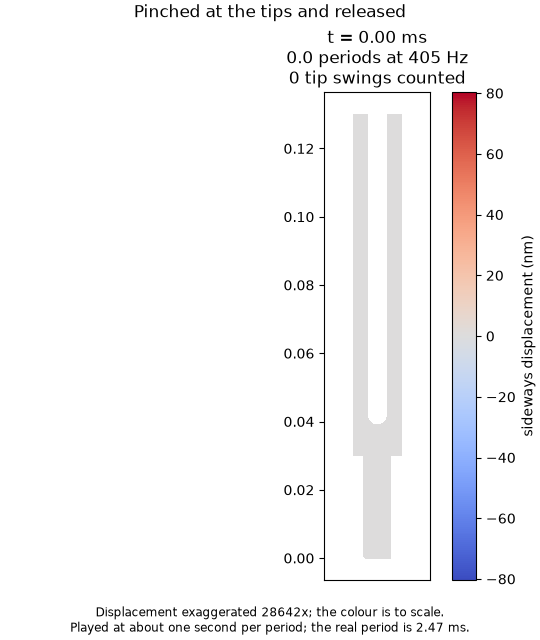
        f'The fork struck, the first {shown_periods} periods of the voice: an equal and '
        'opposite impulse at the two tips, then free vibration by Newmark. The tines '
        'start in a mix of modes, shivering with the high ones, and under Rayleigh '
        'damping those die within a few periods, leaving the tines swinging apart and '
        'together in the voice. The pinch is chosen so the rocking mode (tips swinging '
        'the same way) is never excited: it is lower than the voice and would outlast '
        'it here, where nothing models the hand at the stem that damps it in a real '
        'fork.',
        'struck', frames=len(shown))


def _tuning_law_figure(s: ForkStudy, n_shown) -> Figure:
    law = Plotter(1, 2, title='Against Euler-Bernoulli beam theory')
    curve = law.chart_ax(idx=(0, 0), xlabel='tine length L (m)', ylabel='voice frequency (Hz)')
    curve.loglog(s.sweep_lengths, s.sweep_freqs, 'o', color='tab:blue',
                 label=f'computed fork (slope {s.tuning_slope:.2f})')
    dense = np.linspace(s.sweep_lengths.min(), s.sweep_lengths.max(), 100)
    curve.loglog(dense, cantilever_hz(dense, s.tine_thickness), '-', color='tab:red',
                 alpha=0.6, label='ideal tine  f ~ 1/L^2')
    curve.axvline(s.tine_length, color='0.6', ls=':',
                  label=f'this fork ({s.tine_length*1000:.0f} mm)')
    curve.set_title('Pitch falls as 1/L^2')
    curve.grid(True, which='both', alpha=0.3)
    curve.legend(fontsize='small')

    bars = law.chart_ax(idx=(0, 1), ylabel='frequency (Hz)')
    x = np.arange(n_shown)
    bars.bar(x, s.freqs[:n_shown],
             color=['tab:red' if i == s.voice else 'tab:blue' for i in range(n_shown)])
    bars.axhline(440.0, color='0.4', ls='--', label='concert A (440 Hz)')
    bars.axhline(s.ideal_hz, color='tab:red', ls=':', alpha=0.6,
                 label=f'ideal tine ({s.ideal_hz:.0f} Hz)')
    bars.set_xticks(x, [str(i + 1) for i in range(n_shown)])
    bars.set_xlabel('mode')
    bars.set_title('First modes (voice in red)')
    bars.grid(True, axis='y', alpha=0.3)
    bars.legend(fontsize='small')
    return Figure(
        law,
        'Left: the fork is a pair of clamped-free tines, so beam theory sets its '
        'voice at f = (1.875)^2 / (2 pi) . (t / L^2) . sqrt(E* / 12 rho), the pitch '
        'falling as 1/L^2. Sweeping the tine length, the computed fork tracks that '
        'slope and sits a little below the ideal-tine line, because a real fork\'s '
        'base yields where beam theory assumes a rigid clamp. Right: this fork\'s '
        'first modes: the voice (red) lands near concert A, a few percent under '
        'the ideal tine for the same base-compliance reason.',
        'law')


def _ring_down_figure(s: ForkStudy) -> Figure:
    t, tip_x = s.ringing.t, s.tip_trace
    after_tap = t > s.tap_length
    sigma = s.decay_rate(s.voice)
    envelope = np.abs(tip_x[after_tap]).max() * np.exp(-sigma * (t - s.tap_length))
    # The tip's spectrum: the tap excites every mode, and the peaks sit on the computed
    # frequencies.
    spectrum = np.abs(np.fft.rfft(tip_x[after_tap]))
    spectrum_f = np.fft.rfftfreq(int(after_tap.sum()), d=float(t[1] - t[0]))

    rung = Plotter(1, 2, title='Pinched and released, ringing down')
    trace = rung.chart_ax(idx=(0, 0), xlabel='time (ms)', ylabel='tip sideways displacement (m)')
    trace.plot(1e3 * t, tip_x, color='tab:blue', lw=0.8, label='right tine tip')
    trace.plot(1e3 * t, envelope, '--', color='tab:red', alpha=0.7,
               label=f"the voice's decay, exp(-{sigma:.0f} t)")
    trace.plot(1e3 * t, -envelope, '--', color='tab:red', alpha=0.7)
    trace.set_title(f'A {1e3 * s.tap_length:.2f} ms pinch, then free vibration')
    trace.grid(True, alpha=0.3)
    trace.legend(fontsize='small')

    peaks = rung.chart_ax(idx=(0, 1), xlabel='frequency (Hz)', ylabel='amplitude')
    shown_f = spectrum_f <= 1.2 * s.freqs[-1]
    peaks.plot(spectrum_f[shown_f], spectrum[shown_f], color='tab:blue', lw=1.0)
    for i, f in enumerate(s.freqs):
        peaks.axvline(f, color='tab:red' if i == s.voice else '0.6', ls=':', alpha=0.8)
    peaks.set_title('Spectrum of the tip motion, computed modes dotted')
    peaks.grid(True, alpha=0.3)
    return Figure(
        rung,
        'The same pinch over the whole run. Left, the tip trace rings down inside '
        "the voice's own decay envelope under the Rayleigh damping C = alpha M + "
        'beta K, whose beta term damps each mode in proportion to its frequency '
        'squared. Right, the spectrum of the trace: one peak, on the frequency the '
        'eigensolve found for the voice (red). The overtones the pinch excited '
        '(dotted, grey) have been damped out within the first few periods, and the '
        'rocking mode below the voice is absent because the pinch never excites it.',
        'ring-down')


def _setup_figure(s: ForkStudy) -> Figure:
    built = Plotter(1, 2, figsize=(6.0, 7.0), title='From an outline to a meshed fork')
    built.plot(s.mesh, mode='mesh', idx=(0, 0), title=f'{len(s.mesh.elements)} triangles')
    hide_x_ticks(built, (0, 0))
    built.plot(s.mesh, mode='bc', conditions=clamp, idx=(0, 1), title='Clamped at the stem base')
    return Figure(
        built,
        'The fork is one non-convex outline (stem, base, two tines with a slot) '
        'meshed by Ruppert\'s algorithm, with no structured grid. It is held only at '
        'the stem base: that clamp grounds the structure (a free body has rigid-body '
        'modes the shift-invert eigensolve cannot factor through) and is where a fork '
        'is held, the one place that does not damp the voice.',
        'built', setup=True)


def _summary(s: ForkStudy, n_shown) -> str:
    voice_hz = s.freqs[s.voice]
    period_ms = 1e3 / voice_hz
    return (
        f'A steel tuning fork (E={E:.0e} Pa, rho={RHO:.0f} kg/m^3), meshed from its outline.\n'
        f'tine length x thickness   {s.tine_length*1000:.0f} x {s.tine_thickness*1000:.1f} mm\n'
        f'mesh                      {len(s.mesh.elements)} P2 triangles\n\n'
        f'ideal clamped tine (beam theory)   {s.ideal_hz:.0f} Hz\n'
        f'fork voice (mode {s.voice+1}, computed)      {voice_hz:.0f} Hz   '
        f'({100*(voice_hz/s.ideal_hz - 1):+.0f}%: the base is not a rigid clamp)\n'
        f'first {n_shown} modes (Hz)             '
        + '  '.join(f'{f:.0f}' for f in s.freqs[:n_shown]) + '\n'
        f'tuning law   f ~ L^{s.tuning_slope:.2f}         (beam-theory exponent -2)\n'
        f'struck: Rayleigh damping alpha = {s.damping.alpha:.0f} /s, '
        f'beta = {s.damping.beta:.2e} s; the voice at 1/e after '
        f'{s.ring_down_periods:.0f} periods ({s.ring_down_periods * period_ms:.0f} ms); '
        f'mode {n_shown} ({s.freqs[n_shown - 1]:.0f} Hz) after '
        f'{1e3 / s.decay_rate(n_shown - 1):.1f} ms'
    )


def demo(n_shown=4, shown_periods=6, frames_per_period=8, **kwargs) -> DemoResult:
    """Natural frequencies and modes of a steel tuning fork meshed from its outline,
    against beam theory; then the fork struck and ringing down."""
    s = run(**kwargs)
    return DemoResult([
        _modes_figure(s, n_shown),
        _struck_figure(s, shown_periods, frames_per_period),
        _ring_down_figure(s),
        _tuning_law_figure(s, n_shown),
        _setup_figure(s),
    ], text=_summary(s, n_shown))


DEMO = Demo('modal', demo, section='Solids & structures',
            show_source=physics,
            smoke_kwargs={'n_across_tine': 3, 'min_angle': 25, 'n_modes': 4, 'n_shown': 3,
                          'sweep_lengths': (0.088, 0.125), 'shown_periods': 2,
                          'ring_periods': 3, 'steps_per_period': 12})