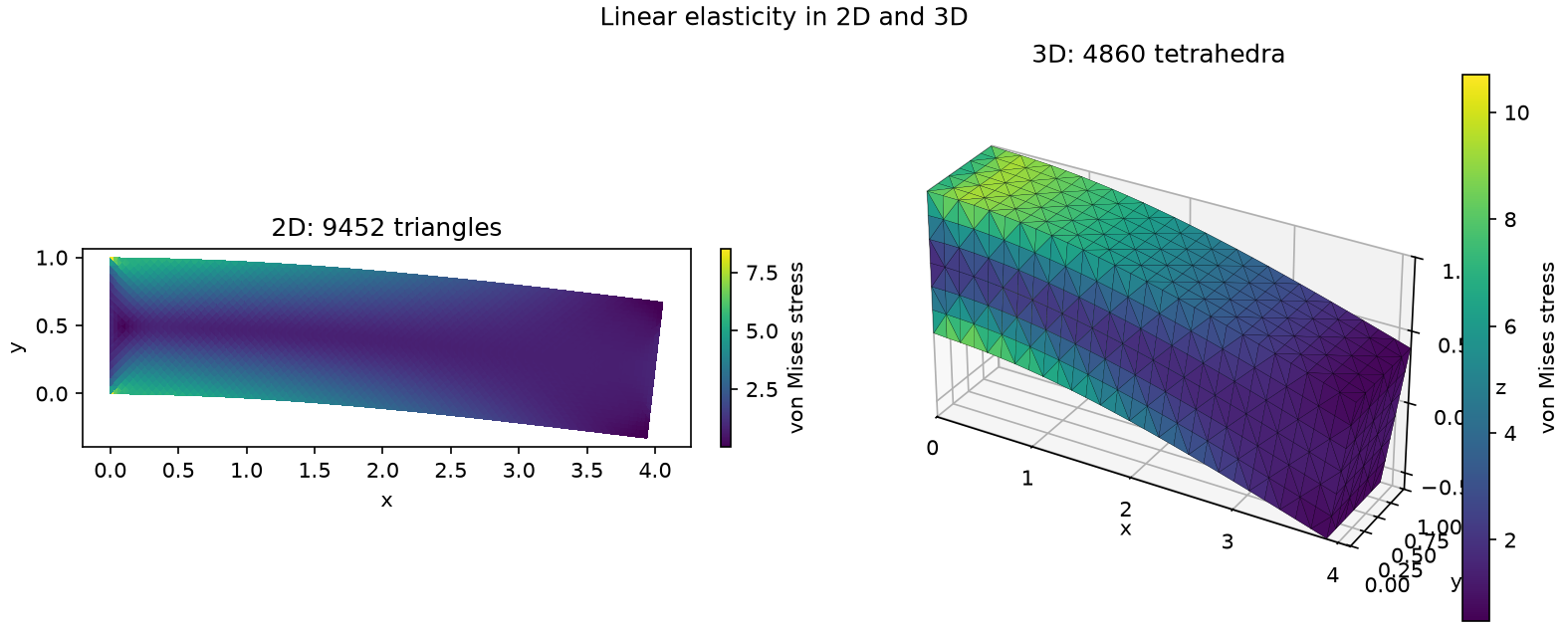
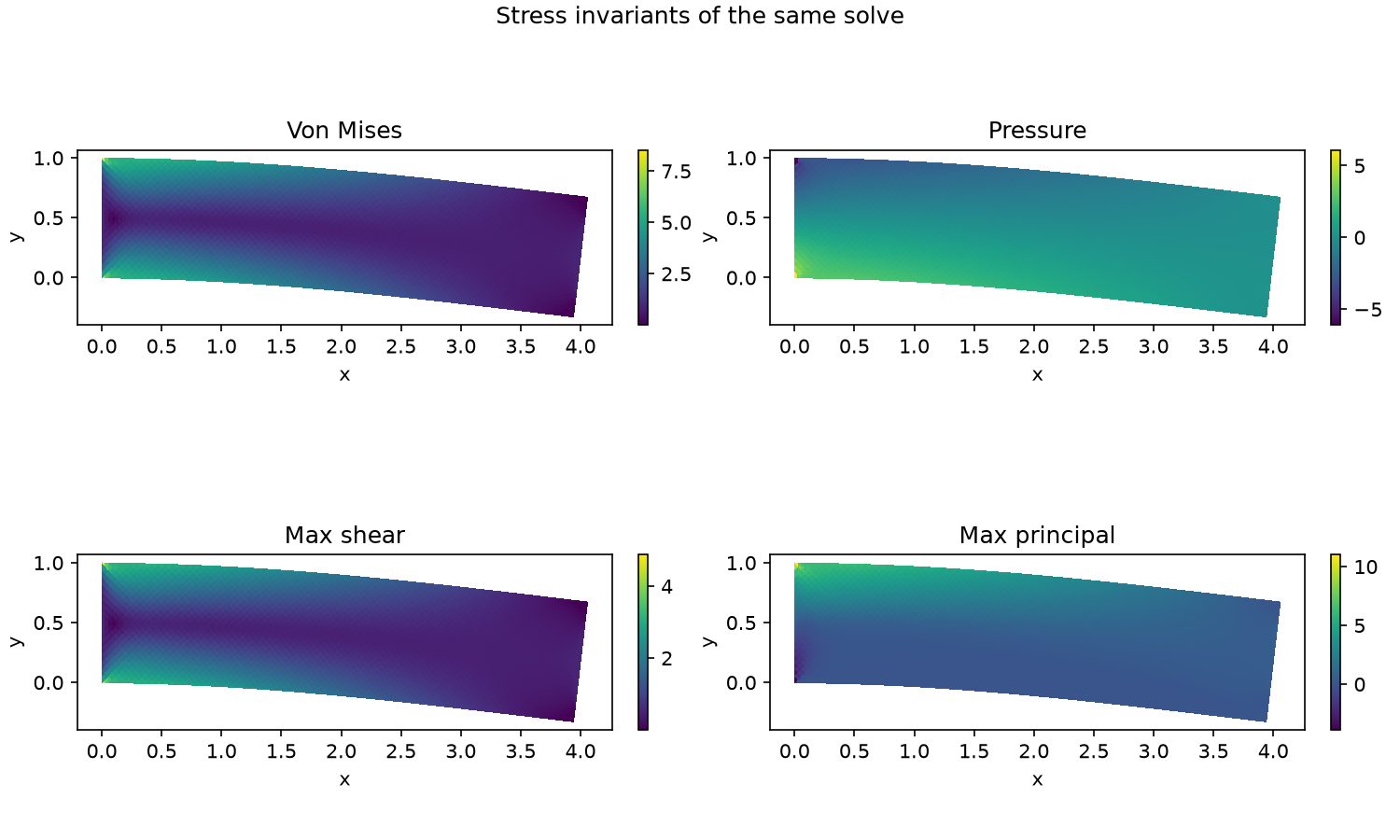
A cantilever under a tip load in 2D and 3D, with four stress invariants of the 2D solve.
uv run python examples/cli.py run linear_elastic
2D triangles           9452
3D tetrahedra          4860
3D degrees of freedom  4116
3D peak deflection     0.6144
The functions that pose and solve the problem. The figures are below the fold.
"""A cantilever under a tip load, in 2D and 3D.

`bend_2d` and `bend_3d` each state and solve one problem; `run` calls them and returns
a `CantileverStudy` of plain results. Nothing here draws: `figures.py` does that from
the `CantileverStudy`, and this file is what the gallery shows.
"""
from dataclasses import dataclass

import numpy as np

from fem.algebra.backends import IterativeBackend
from fem.boundary import Dirichlet, Neumann
from fem.conditions import Conditions
from fem.mesh.mesh import Mesh
from fem.mesh.structured import box_mesh
from fem.physics.equations import LinearElastic
from fem.post.solution import ElasticSolution
from fem.regions import in_box, intersect, on_plane

E, NU = 200.0, 0.4


def clamp_and_tip_load(width) -> Conditions:
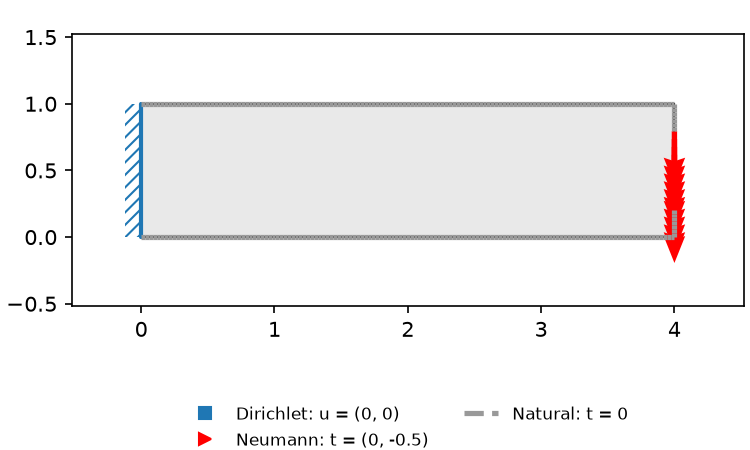
    """Clamped on the left, pulled down over the middle of the right edge."""
    return Conditions(
        Dirichlet(on_plane(0, 0.0), [0, 0]),
        # Transverse, so the beam bends. Sized for a tip deflection near 9% of the span,
        # inside the small-strain regime.
        Neumann(intersect(on_plane(0, width), in_box([None, 0.2], [None, 0.8])), [0, -0.5]),
    )


def bend_2d(mesh: Mesh, bc: Conditions) -> ElasticSolution:
    """The 2D cantilever solve."""
    return LinearElastic(E, NU).problem(mesh, bc).solve()


def bend_3d(n_3d) -> tuple[Mesh, ElasticSolution]:
    """The same clamp-and-load, one dimension up.

    The same assembly, the equation reading the tetrahedron off the connectivity. AMG-CG
    rather than a direct factorization, whose fill-in hurts in 3D.
    """
    box = box_mesh(corners=[[0, 0, 0], [4, 1, 1]],
                          resolution=(4 * n_3d // 2, n_3d // 2, n_3d // 2))
    bc_3d = Conditions(
        Dirichlet(on_plane(0, 0.0), [0, 0, 0]),
        Neumann(on_plane(0, 4.0), [0, 0, -0.5]),
    )
    solution = LinearElastic(E, NU).problem(box, bc_3d).with_backend(IterativeBackend()).solve()
    return box, solution


@dataclass
class CantileverStudy:
    """Everything `run` computed, for the figures and the summary to read."""
    mesh: Mesh
    bc: Conditions
    solution: ElasticSolution
    box: Mesh
    solution_3d: ElasticSolution

    @property
    def tip_3d(self) -> float:
        """The 3D solve's largest vertical deflection."""
        return float(np.abs(self.solution_3d.component(2)).max())

    @property
    def invariants(self) -> list[tuple[str, np.ndarray]]:
        """Rotation-invariant reductions of the 2D stress tensor: von Mises, mean normal
        stress, the Tresca measure, and the largest tensile principal value."""
        s = self.solution
        return [
            ('Von Mises', s.von_mises),
            ('Pressure', s.pressure),
            ('Max shear', s.max_shear),
            ('Max principal', s.principal_stress[:, -1]),
        ]


def run(mesh: Mesh, n_3d=14) -> CantileverStudy:
    """Solve the cantilever in 2D on `mesh` and in 3D on a box `n_3d` deep."""
    bc = clamp_and_tip_load(np.max(mesh.vertices[:, 0]))
    solution = bend_2d(mesh, bc)
    box, solution_3d = bend_3d(n_3d)
    return CantileverStudy(mesh, bc, solution, box, solution_3d)
"""The figures and summary of the cantilever demo, drawn from a `CantileverStudy`."""
from functools import partial

from demo_registry import Demo, DemoResult, Figure

from demos._charts import conditions_figure
from demos.linear_elastic import physics
from demos.linear_elastic.physics import CantileverStudy, run
from fem.mesh.structured import box_mesh
from fem.plot.plotter import Plotter


def _fields_figure(s: CantileverStudy) -> Figure:
    fields = Plotter(1, 2, figsize=(10.5, 4.2), title='Linear elasticity in 2D and 3D')
    fields.plot(s.solution.deformed_mesh(), s.solution.von_mises, mode='colored', idx=(0, 0),
                label='von Mises stress', title=f'2D: {len(s.mesh.elements)} triangles')
    # Only the boundary surface is drawn.
    fields.plot(s.solution_3d.deformed_mesh(), s.solution_3d.von_mises, mode='solid',
                idx=(0, 1), label='von Mises stress',
                title=f'3D: {len(s.box.elements)} tetrahedra')
    return Figure(
        fields,
        'The same clamp and load solved in 2D and 3D. The bending stress is largest '
        'at the clamp, with tension over the neutral axis and compression under it. '
        'The 3D solve carries a three-component displacement and recovers stress the '
        'same way, drawn on its boundary surface.',
        'fields')


def _invariants_figure(s: CantileverStudy) -> Figure:
    deformed = s.solution.deformed_mesh()
    invariants = Plotter(2, 2, title='Stress invariants of the same solve', panel_aspect=4.0)
    for i, (name, values) in enumerate(s.invariants):
        invariants.plot(deformed, values, mode='colored', idx=divmod(i, 2), title=name)
    return Figure(
        invariants,
        'Four rotation-invariant reductions of the same 2D stress tensor: von Mises, '
        'mean normal stress, the Tresca measure, and the largest tensile principal '
        'value.',
        'invariants')


def _conditions_figure(s: CantileverStudy) -> Figure:
    return conditions_figure(
        s.mesh, s.bc,
        'Clamped along the left edge, pulled down over the middle of the right one; '
        'everything between is traction-free. The 3D solve imposes the same clamp '
        'and tip load, one dimension up.',
        panel_aspect=4.0)


def _summary(s: CantileverStudy) -> str:
    return (f'2D triangles           {len(s.mesh.elements)}\n'
            f'3D tetrahedra          {len(s.box.elements)}\n'
            f'3D degrees of freedom  {3 * len(s.box.vertices)}\n'
            f'3D peak deflection     {s.tip_3d:.4f}')


def demo(mesh, **kwargs) -> DemoResult:
    """A cantilever under a tip load in 2D and 3D, with four stress invariants of the 2D
    solve."""
    s = run(mesh, **kwargs)
    return DemoResult([
        _fields_figure(s),
        _invariants_figure(s),
        _conditions_figure(s),
    ], text=_summary(s))


# The 2D cantilever whose domain this is, plus a 3D box the demo builds for itself.
DEMO = Demo('linear_elastic', demo, section='Solids & structures',
            domain=partial(box_mesh, [[0.0, 0.0], [4.0, 1.0]], (140, 35)), smoke_kwargs={'n_3d': 6},
            show_source=physics)